draw a decision tree for the premium airlines settlement

Customized Plan

Settlement Team

Project Manager

Measureable Results

Increased Savings
Reduction
in Open
Claims 0%
Reduction in
Attorney
Referrals 0%
Reduction in
CMS Approved
MSA Amounts 0%
Reduction in
Total Claim
Costs 0%
Reduction in
Pharmacy
Costs 0%
FEATURES & BENEFITS
- Aggressively and quickly closes portfolio of legacy claims
- Positions claims that do not settle for on-going cost reduction
- Frees adjusters and case managers to focus on complex, active claims
- Increases overall program savings
- Customized to your needs and workflows
- Project Manager coordinates all aspects
- Dedicated legacy claims settlement team
- Settlement broker-partner finalizes settlement
THE LEGACY CLAIMS PROCESS
- Establish Settlement Thresholds
- Identify Settlement Partners
- Determined Timeframes
- Execute MSA Optimization / Interventions
- MSA or Pre-MSA Triage
- Close Legacy Claim Files
- Define Ongoing Claims Management Boundaries / Triggers
CASE STUDY: AMERICAN AIRLINES SETTLEMENT PROJECT

CHALLENGE
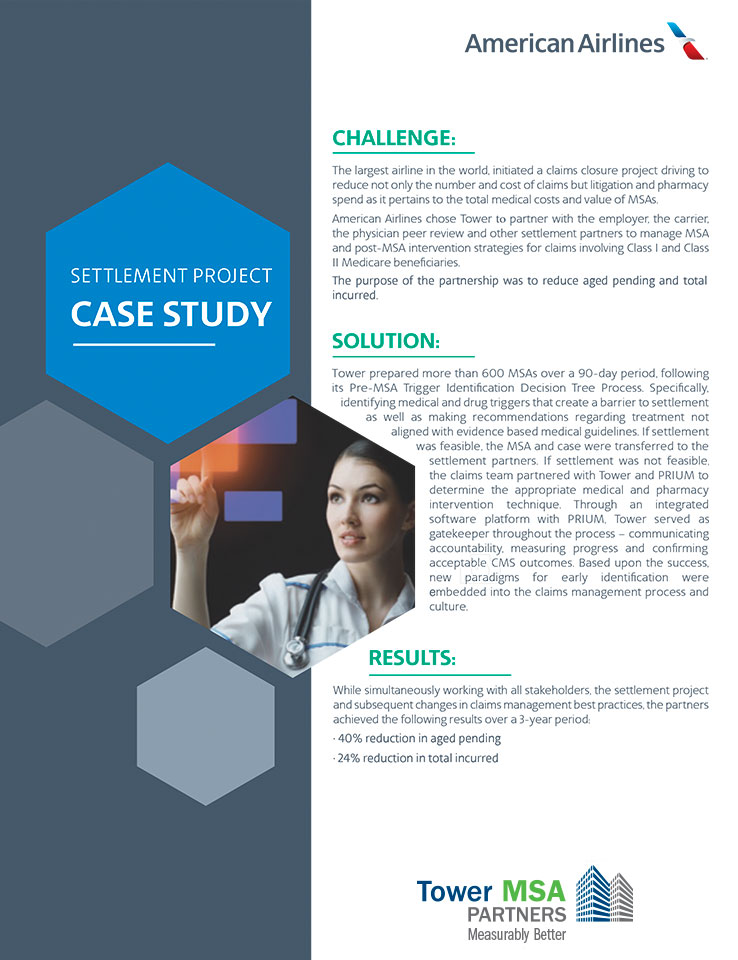
The largest airline in the world, initiated a claims closure project driving to reduce not only the number and cost of claims but litigation and pharmacy spend as it pertains to the total medical costs and value of MSAs. American Airlines chose Tower to partner with the employer, the carrier, the physician peer review and other settlement partners to manage MSA and post-MSA intervention strategies for claims involving Class I and Class II Medicare beneficiaries.

SOLUTION
Tower prepared more than 600 MSAs over a 90-day period, following its Pre-MSA Trigger Identification Decision Tree Process. Specifically, identifying medical and drug triggers that create a barrier to settlement as well as making recommendations regarding treatment not aligned with evidence based medical guidelines. If settlement was feasible, the MSA and case were transferred to the settlement partners. If settlement was not feasible, the claims team partnered with Tower and PRIUM to determine the appropriate medical and pharmacy intervention technique. Through an integrated software platform with PRIUM, Tower served as gatekeeper throughout the process – communicating accountability, measuring progress and confirming acceptable CMS outcomes. Based upon the success, new paradigms for early identification were embedded into the claims management process and culture.

RESULT
While simultaneously working with all stakeholders, the settlement project and subsequent changes in claims management best practices, the partners achieved the following results over a 3-year period: •40% reduction in aged pending •24% reduction in total incurred
CASE STUDY: MSA Optimization
CHALLENGE
Tower was engaged to prepare an MSA for a 54 year old partial quadriplegic. The lack of current medical records, the erratic behavior of the patient, the quality of the provider's treatment coding, and unknown treatment outside of the WC Plan were challenges to preparing an accurate MSA. The preliminary MSA amount was $424,528.
SOLUTION
In review of the treatment records, Tower's medical experts were able to identify several instances where Medicare covered expenses could be reduced as part of Tower's Optimized MSA process. At Tower's request, the client obtained current medical records. Tower's clinical team reviewed those records and the corresponding billing codes used for all treatments. By analyzing the provider's treatment methods against Medicare's reimbursement requirements, Tower was able to identify items that were more accurately priced with alternative codes. One instance identified was a determination that a catherization code (A4353) was used incorrectly. By using the correct billing code and applying other cost savings strategies to the treatment regimen, the MSA dollars were significantly reduced. To ensure that CMS would accept the updated medical coding, Tower detailed how the original billing code was incorrectly used and then provided the correct coding.
RESULT
Upon finalization of the optimized MSA, a total allocation amount of $248,661 was submitted to CMS for review and approval. CMS accepted the proposed MSA amount and responded with a Full Approval. Using Tower's proprietary processes and technology, the client carrier was able to reduce the Medicare exposure of this settlement resulting in total savings of $175,867.
CASE STUDY: PRE-MSA TRIAGE
CHALLENGE
Case submitted to Tower for Pre-MSA Triage to assess Medicare exposure. In 2010, worker was doing electrical line work when he was struck by lightning. Injuries included electric shock with pain, insomnia, depression and seizure activity. Treatment included prescription drugs as follows: Hydrocodone/APAP (7.5 / 325 mg at 4 / day), Baclofen (muscle relaxant), Topamax (anti-seizure), Cymbalta (antidepressant), Keppra (anti-convulsant), Naproxen (pain), Clonazepam (anti-anxiety).
SOLUTION
As part of the standard Pre-MSA Triage process, Tower's clinical team identified the key cost drivers, made recommendations within the context of the state of jurisdiction to optimize the drug regimen, documented recommendations to achieve the desired result, and calculated the optimized MSA value at $641,930. In this case, recommended next steps included Tower's Physician Follow Up service to contact the injured worker and treating physician to request a change from 'Brand' to 'Generic' formulation for Topamax and Keppra.
RESULT
With client approval, Tower used the information prepared with the PreMSA Triage, added the attestations obtained from both injured worker and physician noting that substitution was allowed for both Topamax and Keppra and finalized the MSA for submission to CMS. In its review, CMS accepted the attestations as confirmation of the change in drug therapy and approved Tower's submitted MSA at $641,930.
CASE STUDY: SETTLEMENT PROJECT
CHALLENGE
A large, national employer inherited legacy claims through a merger / acquisition transaction increasing total open claims to 5,000 with total reserves at greater than 695,000,000.
SOLUTION
Tower prepared more than 600 MSAs over a 90-day period, following its Pre-MSA Trigger Identification Decision Tree process; To identify medical and drug triggers that created a barrier to settlement, and to make recommendations regarding treatment not aligned with evidence based medical guidelines.
RESULT
Working in tandem with all stakeholders, the settlement project and subsequent changes in claims management best practices achieved a drastic amount of savings.
Tower truly stands out as the premier partner when it comes to anything regarding Medicare Set Asides. Their commitment to providing quality and timely information is the best in the industry."
CONTACT US FOR A FREE CONSULTATION.
Source: https://towermsa.com/legacy-claims-settlement-initiatives/
0 Response to "draw a decision tree for the premium airlines settlement"
Post a Comment